
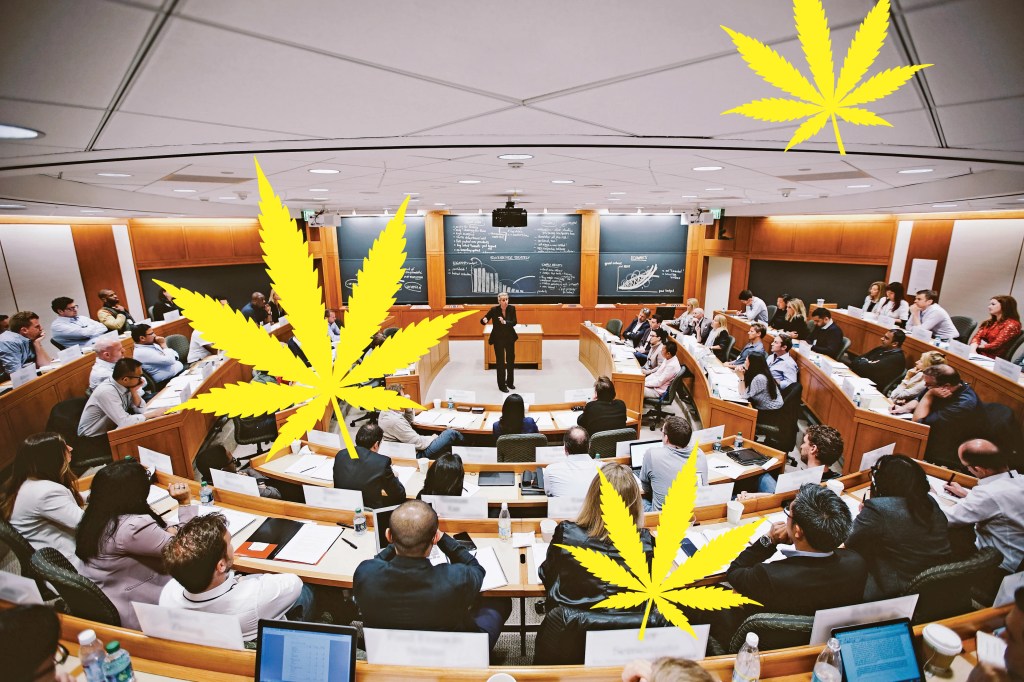
Cambridge, MA—In a surprising twist that has raised eyebrows in the business community, Harvard Business School (HBS) has announced a new MBA course designed to showcase unsustainable business strategies using a very specific example: the cannabis industry’s relentless cycle of daily deals and Buy-One-Get-One (BOGO) offers. Titled “Growth Without a BOGO: Lessons in Sustainable Strategy,” the course will dissect the pitfalls of deal-driven growth and examine how a seemingly booming industry can still find itself teetering on the brink of profitability.
“For too long, business students have focused on textbook success stories,” said Professor Henry Conners, the new course’s architect. “We wanted to show them what not to do. And when it came to finding a perfect case study in unsustainable pricing, we needed to look no further than the cannabis industry, where every day is a BOGO, and every sale comes with the vague promise of profitability that never seems to materialize.”
The Syllabus: A Step-by-Step Guide to Not Going Broke
BOGO culture, flash sales, endless discounting—these are the strategies the cannabis industry has relied on to drive foot traffic, albeit at the expense of financial health. Each week, students will examine different aspects of how these tactics have undermined the cannabis sector’s long-term success.
Key lessons include:
- “The BOGO Trap”: This module explores how cannabis retailers offer endless Buy-One-Get-One deals to create a sense of urgency. Students will investigate how this has trained customers to expect perpetual discounts, resulting in what Professor Conners calls “a bottomless pit of unsustainable expectations.”
- “Flash Sale Fatigue”: Students will learn how weekly flash sales and daily deals in cannabis retail have turned an entire customer base into discount hunters. “One day it’s BOGO gummies; the next, it’s half-off vapes,” explains Conners. “This creates a warped relationship with price where customers are never willing to pay full price, and brands are left to wonder why they can’t turn a profit.”
- “The Price Elasticity Black Hole”: Covering the dangers of endless discounting, this unit addresses how cannabis retailers have essentially eliminated price elasticity, making it impossible to increase prices without a backlash. “By reducing every product to a deal or a discount, the cannabis industry has eroded any sense of value and tanked their own margins,” says co-instructor Dr. Margot Lin.
Guest Lecturers: Ex-Cannabis Executives Share Tales from the Trenches
To bring real-world context to the course, HBS has enlisted former executives from the cannabis sector who’ve spent years in the trenches of discount-driven growth. Many of them, having watched their companies sink under the weight of constant promotions, are eager to help future leaders avoid the same fate.
“Everyone in cannabis was so focused on keeping customers in the door that we forgot about keeping cash in the bank,” said guest lecturer Dale Jennings, former VP of Retail Strategy at an unnamed cannabis chain. “I’m here to show students what happens when you rely on flash sales to drive revenue instead of focusing on actual business fundamentals.”
In his guest lecture, “How to Lose Money Faster,” Jennings recounts how his company launched a weekly “Bargain Buds” promo, offering 40% off the entire store. While foot traffic soared, profits quickly went up in smoke. “It turns out that when you train customers to expect a sale every day, they won’t come in unless there is one,” Jennings explains. “And then, eventually, they don’t come in at all, because even they can sense the desperation.”
Industry Insights: How Not to Scale a Business
A key part of the course will be a deep dive into how unsustainable pricing strategies, driven by competitive desperation and lack of customer education, created a race to the bottom for the cannabis industry.
“Cannabis was supposed to be the new frontier of retail, but instead of creating lasting value, many companies adopted tactics designed for liquidation sales,” said Conners. “For instance, promotions like ‘Three for the Price of One’ may fill baskets in the short term, but they completely destroy the perception of value. Customers start to think, ‘Wait, if this is always half-off, what’s the real price?’ That’s not a customer relationship; it’s a crisis of confidence.”
Why Harvard is Making Unsustainable Business Strategy a Core MBA Lesson
While the course pokes fun at the wild world of cannabis discounting, the implications are serious. HBS hopes that by teaching students how unsustainable growth can tank an entire industry, future leaders will prioritize stable, long-term strategies.
“Cannabis retailers have created an invaluable case study in how not to build a business,” Conners remarked. “Our students are learning that sustainable success doesn’t come from wild daily discounts, flash sales, and ‘Buy One, Get Three Free’ promotions. It comes from building genuine brand loyalty, valuing product quality, and setting expectations that don’t involve giving half the store away.”
A Reality Check for MBA Students
Despite the humorous undertone, Harvard’s new course is a timely warning. “As cannabis companies burn through cash, we want our students to learn that you can’t discount your way to profitability,” said Dr. Lin. “By studying the cannabis industry, our students can see exactly what happens when companies rely too heavily on short-term sales and fail to think about sustainable growth.”
One thing is for sure: when Harvard Business School students are taught to avoid the tactics that made the cannabis industry infamous for unsustainable pricing, the next generation of business leaders might just be less inclined to make a business model that lives and dies by the BOGO.




 POTLITICO
Leave a comment